
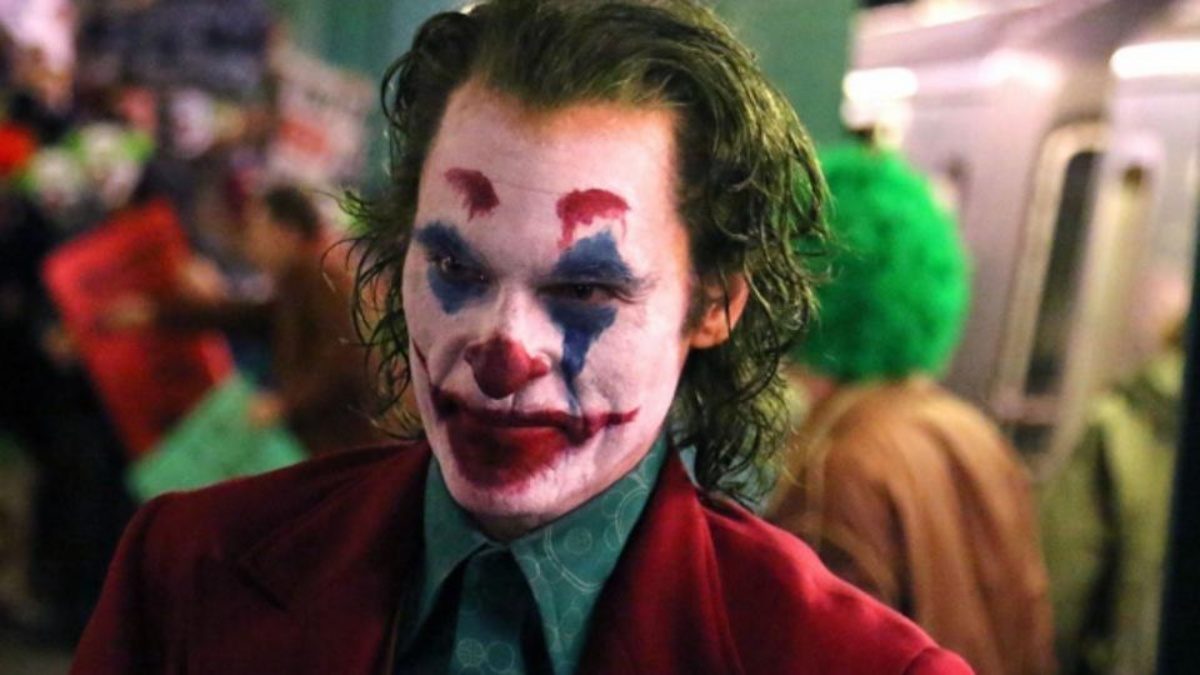
The Joker emerges from his grey larval form Arthur Fleck (A.Fleck geddit?) like a colourful butterfly. He dances carefree down the grimy set of stairs that represented his torment earlier in the film. As his feet gracefully caress each step the soundtrack pumps out a forgotten 70s classic, Guardians of the Galaxy style. As your feet tap along with the Joker’s the micro and meta narratives collide as you realise that the joke is on you, the forgotten classic is performed by convicted paedophile Gary Glitter. The fourth wall collapses faster than a Deadpool quip to camera as real world morality overtakes the fictional world of the 80s Gotham city and you ask yourself how you are singing along with Glitter and sympathising with the Joker. It is almost at the point of realisation that the police turn up and as quickly as you were questioning yourself you forget the problematic morals in favour of rooting for the Joker’s escape.
Just prior to the stairs scene The Joker has just brutally and violently murdered his former co-worker, and its no coincidence that he did so by stabbing the clown in the eye, paralleling our introduction to Heath Ledger’s iconic take on the villain in The Dark Knight. This Joker could not be further from Ledger’s take, or from Leto’s controversial interpretation or Nicholson’s now seemingly by the book version. However the film sets up early on that Fleck is not a character whose point of view can be trusted, its shown repeatedly that his take on reality is not congruent with lived reality. The characters, locations and era could all be figment’s of Fleck’s imagination or fractured memory. This Joker could be the perceived genesis of any Joker that has come before, or it could be none of them. He could even be a tormented DC fan re-imagining his own life through the Joker’s lens. Its odd that a character whose first name is “The” has so many varied and yet equal interpretations.
Retaining some belief that the narrative is an attempt at crafting an origin for the Joker the film delves deeply into some modern concerns for a film set in the 1980s. Social media, reality TV, social decay, class division and mental health provision are all scrutinised by the movie. DeNiro’s excellent Murray Franklin encompasses all talk show hosts past and present and serves as the absent father in the Fleck household visiting nightly with jokes and guest stars to bring levity to Arthur and his mother’s miserable existence. Just like the mechanic of the film itself the reality of the talk show host is a mis-match with the fantasy. Franklin uses footage of Fleck’s wounded stand up to mock him, and then later to bring him on the show. For filmgoers who have laughed at X Factor auditions or Big Brother contestants enjoying a mental breakdown – looking at you Les Dennis – its an indictment of mocking the superficial without understanding what may be behind the performance. In Fleck’s case spitting out a joke at all when battling one of his many mental health issues, a compulsion to laugh when stressed, is a victory worthy of the best X Factor voiceover and Westlife key change. But then sympathising with Fleck in these moments is to forget the ravings in his joke book and the vile imagery and sketched violence that serve as punchlines. It is also interesting that despite Franklin’s TV persona mocking Fleck, when Arthur and Murray meet Murray is actually comforting and accommodating, yet when the cameras roll he is back to scoring points from Arthur’s appearance. Like the Joker’s compulsion to laugh, Murray Franklin has the compulsion to Joke, a bit like Roger Rabbit being unable to resist the old ‘shave and a haircut’ (two bits). Franklin’s punishment for using, and unwittingly naming, the Joker is brutal, satisfying and horrific.
The Joker can be seen as a medicated persona, tucked away in Arthur’s mind forcing himself out whenever Arthur is stressed via his uncontrollable laughter. This persona existing within Arthur like a more realistic version of the Incredible Hulk. Arthur defends himself against an attack on the subway with lethal force however the media and the public portray him as a psychotic killer and symbol of rebellion against the 1% respectively. In previous incarnations the Joker has used Smilex gas to kill and duplicate himself amongst his victims. In the final scenes of the film in a city full of smoke and the people take his image as inspiration, smilex in this world is finding your heroes in the wrong places. The Joker is a meme, he is the photo of a whatsapp chat group or a tattoo on everyone’s arm. Echoing the ending of the Dark Knight the Joker is the hero Gotham needs right now, which says more about Gotham than it does about the Joker.
The Joker’s relationships with his mother, his neighbour Sophie and Thomas Wayne are all subject to narrative revision, his girlfriend offering tenderness and support is a stranger, his mother for whom Arthur cares tenderly is actually his greatest oppressor and Thomas Wayne is a stranger, his dad and yet another perpetrator of violence against Arthur. All evidence points towards any scene being a fantasy, edited reality or actual reality. Fleck’s confrontation with Wayne in a toilet may not have even happened, the photo and its semi innocent message seems to confirm his mother’s ravings but if The Joker’s mind can fake a girlfriend, it can fake a photo. And in this editing of reality we have The Joker’s final victory.
The Joker appears in every scene in the film, with one exception, the murder of Bruce Wayne’s parents Thomas and Martha by a rioter dressed as a clown looking to emulate The Joker’s perceived political message of attacking the rich. However in the final scene with the psychiatrist Arthur briefly remembers the scene while laughing. The Psychiatrist asks what Arthur thinks is funny, he replies “A joke” and that she “Wouldn’t get it”. How is the Joker remembering an event he didn’t witness? Did he replace himself in the narrative with a random goon in a mask? Or is the joke a second narrative in Arthur’s mind? A narrative inspired by news stories and jokes about Super Rodents and Super Cats, a narrative about an orphan boy free of stepfather abuse growing up to fight crime? To redeem the name of Wayne? Arthur even meets Alfred and sees the child Bruce slide down a pole. The final Joke of this Joker is that Batman, the reckoning that Gotham needs is a figment of his imagination.

 Film Thought