
The term “Manbaby” was coined by Last Jedi director Rian Johnson as early as February 2018, but used several times subsequently, including when he criticised online trolls (I hesitate to use the term fans) for hounding Kellie Marie Tran on social media (which was publicised in June 2018). Regardless of the sincerity of the term’s origins as a result the term “Man Baby” has become associated with the division caused by 2017’s Star Wars: The Last Jedi. For the label “Manbaby” to be meaningful in the context it is used, i.e. as an insuly, it must be based on the the unflattering juxtaposition of two opposites. The man is a grown up responsible person, possibly a symbol of strength and/or wisdom, the voice of experience. Whilst the opposite, the baby, is a juvenile, uncontrollable and prone to tantrums and emotion fuelled irrationality. If we examine the presentation of the Luke Skywalker character in The Last Jedi many tropes that fit this definition of a Manbaby are evident. Based on this I would argue that the first Star Wars man baby was not an online troll or youtuber, but in fact it Star Wars icon Luke Skywalker (at least as envisioned by Rian Johnson).

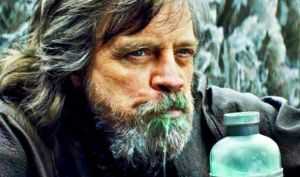
The most impactful and ‘on the nose’ visual realisation of Luke Skywalker as a manbaby occurs early in the film and establishes the perception of him by both the audience and lead character Rey. It is the scene in which he essentially breast feeds from the Thala Siren on the Island of Ach-To. The scene shows Luke, in uncomfortable close up, expressing milk from the Thala Siren directly into a bottle, which he drinks from. The bottle is only the briefest intermediary from Luke literally breast feeding, he doesn’t pasteurise or treat the milk, he drinks it immediately and in the presence of both the Thala Siren and Rey. He is also covered in the milk, it is all over the bottom half of his face, he is messy, like a child, like a baby. Adult breastfeeding is often seen as a cultural taboo, In the first season of Game of Thrones the character Lysa Arryn breastfeeds her pre-teen child Robert Arryn in a scene that is meant to show that she is both unhinged and shares an unnaturally intimate bond with him (spoiler alert – it is this bond that motivated her to kill her husband). In BBC comedy The League of Gentlemen, serial killers Tubbs and Edward engage in adult breastfeeding in a shocking scene that precedes murder. The scene of Luke breastfeeding is a diametric contrast to the serene and angelic vision of the character presented at the end of The Force Awakens, a film that was predicated on the urgent need to find Luke Skywalker. It is also a bizarre reprise of one of Luke’s earliest scenes in A New Hope where he drinks blue milk at the dinner table with Uncle Owen and Aunt Beru. This scene and its referencing shows that Luke has also regressed to a point before his earliest screem appearance (not counting Episode 3), when the character was whiny, impulsive and immature, before he grew during that film, and the rest of the Star Wars Trilogy. These may seem like an inconsequential or throwaway scene, but the fully realised puppets of the Thala Sirens were only created for this scene at a substantial cost and design effort. Blue milk is an Easter Egg explicitly referenced in the movie Rogue One and blue and green milk are both available at Star Wars Galaxies Edge (Which if you are reading in 2025 used to be a Star Wars themed land in Disneyworld). The depiction of Luke drinking like this is a costly and deliberate statement, it is a visual callback that informs the viewer that Luke, has regressed he is presented, unflatteringly as both a manbaby.
In his defining moment, at the pinnacle of his story arc in Return of the Jedi, Luke resisted the temptation to cut down his father Darth Vader. The fallen Jedi Anakin Skywalker, a character who had murdered countless innocents and had just promised to either corrupt or kill Luke’s twin sister Leia. Luke achieved this self-actualisation In sight of a hopeless battle, trapped within the second Death Star, confronted by a monstrous and all powerful Emperor. In that moment under extreme stress and provocation Luke embraced the light, the peaceful way of contemplation, he refused to be ruled by base emotions. In doing so he refused to behave like the juvenile he was when audiences first met him. Luke finally grew from his boyhood impulsiveness, from the failure that lead him to Bespin and the loss of his hand and he became a man. By contrast his island exile and his self-imposed isolation from the Force represent denial of the maturation process he went through to become the character he was at the end of Return of the Jedi. What consolidates this regression is the depiction of Luke and what happened when Ben Solo became Kylo Ren. In the flashback scenes, a film device not used before in Star Wars, Luke is enraged when he senses that the sleeping Ben Solo is ‘going over to the dark side’ Luke’s reaction is to ignite his lightsaber, a precurser to attacking and killing his sleeping nephew. Luke’s temptation before the passive, sleeping Ben Solo is the exact opposite of the Return of the Jedi scene referenced above, Luke is within his own compound, he is under no external stress or lengthy provocation, his nephew is asleep, there are on galaxy threatening events unfolding in front of him. And yet Luke regresses, he responds to the merest provocation with extreme and uncontrolled violence, he reacts to distress with immidiate and disproportiante emotion, in short he behaves like a baby. It is the director’s choice to show 3 slightly different versions of Luke losing his temper but show no explanation for quite how sensing troubled sleep is more powerful provocation than what Luke faced on the second Death Star. The focus of the flashbacks are not to illustrate why and how Ben Solo was converted by Snoke, but to show how Luke is an unreliable narrator and not the angelic saviour character presented by the narrative of the Force Awakens and its final scenes. As a side note the white robed Luke quikly undergoes a costume change to fit the change in the character’s direction from Abrams to Johnson. The first rule of cinema is to show and not tell, the creation of the sequel trilogy’s villain and the destruction of the original trilogy’s protagonist is shown with insufficient depth.
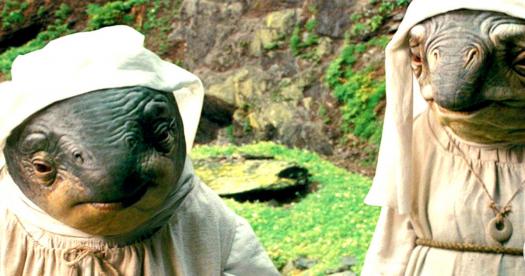
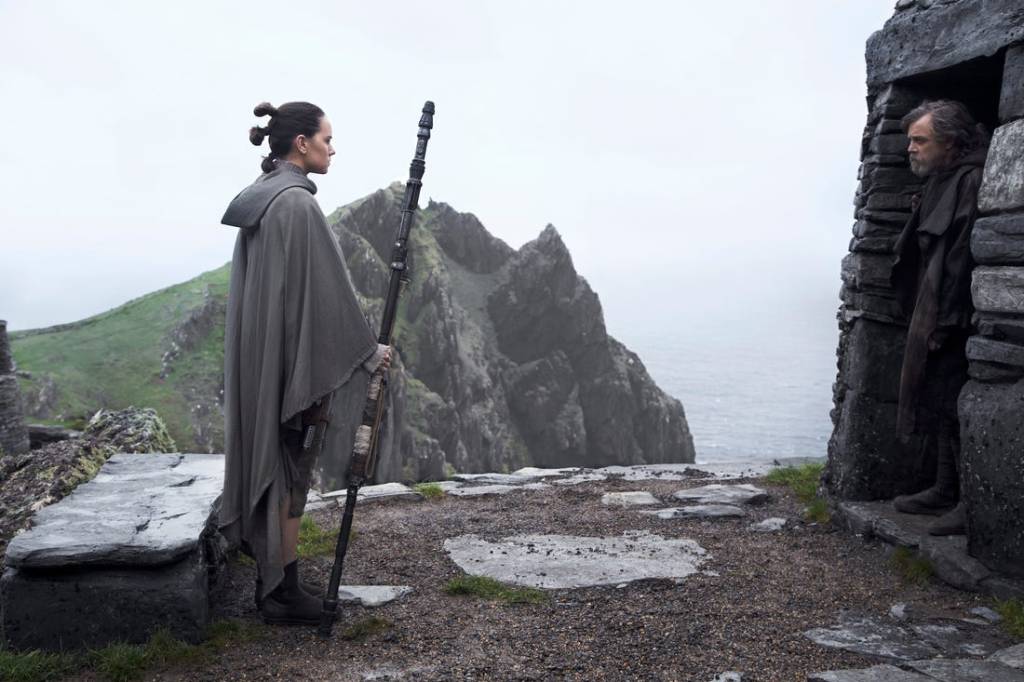
Luke’s response following his temptation to murder a family member is to flee, to ignore his responsibilities to his sister, his best friend, his nephew, the galaxy and the Jedi order. The place he runs to is the birthplace of the Jedi, the planet Ach To. At the end of The Force Awakens Luke is shown to be alone, exiled on the island, however in The Last Jedi three native species are introduced, the Porgs, a penguin like bird, made solely for cutesy moments and merchandising, the Thala Sirens discussed above and the Lanai Caretakers (pictured above). The Caretakers are amphibian in appearance but wear clothing that is not dissimilar to nuns or nurses – both of which are often associated with the care of children. The caretakers attend to Luke and look after him. In contradiction to the brief scenes at the end of the Force Awakens Luke is not really a self reliant character, like Yoda on Dagobah. Instead Luke lives on an island surrounded by literal caretakers, nurses and toys. His rejection of the Force is a rejection of the growth he achieved in the original trilogy, his growth from a child to a grown up. Thematically and literally Luke is no longer a Jedi Knight, or a Jedi Master, he is no longer even a grown up, he is a child. Luke is a child who has rejected his responsibilities in favour of a multi-year temper tantrum, like a child holding its breath for attention Luke is uninterested in helping his sister. Even Yoda’s bizarre regression from wise Jedi Master to the scatty persona he put on in Empire Strikes Back to test Luke seems to mirror the regression experienced by Luke.
The end of Luke’s arc in The Last Jedi is to project himself into the final battle to cause a distraction, an effort that kills him. Luke living up to his potential, to reacquire the growth he achieved at the end of Return of the Jedi leads to his annihilation. And instead of returning Ben Solo to the light, like he did his father, Luke humiliates Kylo and further enrages him. Growing up has never been presented with such finality and futility.
Looking at Luke Skywalker in the Last Jedi he has
- Rejected Responsibility
- Has become dependent on carers
- Reversed his character growth
- Become a slave to emotion
- Is an unreliable narrator
The Luke Skywalker of The Last Jedi is a man who has regressed, a man who has retreated to the literal birthplace of his metaphorical manhood, a man who is prone to self-defeating multi-year temper tantrums, a man who messily breastfeeds. There is much evidence that supports the argument that Luke is presented as a Manbaby, and little or no evidence to the contrary. Luke Skywalker is a cultural icon, a childhood hero to many an important and significant mythological character. to destroy him like this is an act of cinematic vandalism, the box office resceipts for Solo and The Rise of Skywalker seem to support that not only was the last Jedi a narrative failure, but a commercial one as well.
 Film Thought