Spyfall: Part One – Review
James Bond and Doctor Who have always shared a close association over the years. Both are the products of the swinging sixties (Dr. No releasing in 1962, Dr. Who the following year) and both have reinvented themselves numerous times through recasting their leads. And just as you can gauge a person’s age by who is their James Bond, the same calculation can be made for Doctor Who. Given this cultural affiliation its perhaps surprising that the show has resisted tipping its fez to the spy genre for as long as it has, something writer/showrunner Chris Chibnall has addressed with the first story of Jodie Whittaker’s second series, Spyfall. And like the Bond movie the title pastiches, this is a story about the murders of international agents, the modern perils of stolen personal data, returning, presumed dead adversaries and culminates in the ruins of the protagonist’s ancestral home (spoilers! More on that in the review for part 2!). And just like Skyfall, this version of Doctor Who is the follow up to a lacklustre previous outing. A lot is a stake.
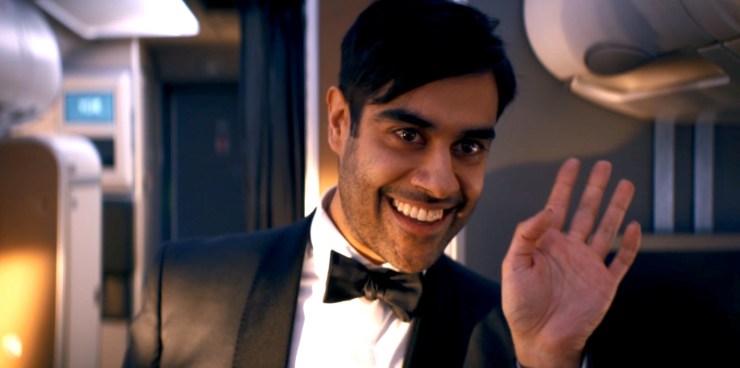
Appropriately for both franchises, the story begins with a cold opening (the first since Capaldi’s swansong, “Twice Upon A Time” in 2017). The Doctor (Jodie Whittaker), Graham (Bradley Walsh), Ryan (Tosin Cole) and Yaz (Mandeep Gill) are summoned by the head of MI6, ‘C’ (Stephen Fry, clearly ticking things off his ‘bucket list’), to Vauxhall Cross to investigate the mysterious deaths of international agents. What’s worse, the bodies have had their DNA altered and their only lead is the enigmatic Daniel Barton (played with understated menace by Lenny Henry). Following C’s brutal assassination, the Doctor and her ‘fam’ escape and split up, with Yaz and Ryan investigating Barton whilst the Doctor and Graham travel to Australia to meet Agent ‘O’ (Sacha Dhawan), a disavowed agent previously tasked with monitoring extra-terrestrial activity (UNIT and Torchwood have disbanded, its explained. Another victim of austerity, presumably). Whilst in Barton’s office, Yaz and Ryan encounter strange, luminescent beings which capture Yaz. Meanwhile, down under the Doctor traps one of the creatures only for it to escape by switching places with the missing Yaz. The TARDIS team reunite with Ryan, and with O in tow, pursue Barton, stowing aboard his private plane as he flies off in it. On board O reveal’s himself to be a regenerated Master whilst Barton disappears from the plane’s controls, leaving a bomb in his place. The device destroys the cockpit and the jet plummets towards the ground as the Doctor and the Master are teleported away, leaving their companions to their fate. Surrounded by other-worldy tentacles rising from the ground, the Doctor discovers she’s been transported to the Upside-Down alien being’s home world/dimension. Cue credits.

The cast and crew have clearly had a ball making Spyfall, and the affectionate nods to Ian Fleming’s world are legion throughout the 60-minute run-time, although some are more successful than others. And whilst “rocket cufflinks” and “laser shoes” might feel like they belong more to Johnny English than James Bond, there are also meetings with MI6, car chases and musical motifs aplenty. At one point the Doctor even introduces herself with, “The name’s Doctor – The Doctor”. It’s not subtle but it’s good natured fun and the action moves along at a good pace. It’s certainly an improvement over the last series, which for all its good intentions often plodded along lethargically. If the mission statement for this season is to give things a kick up the backside, it seems to be working. There is also some improvement over the previous series in both the characterization, and portrayal of the companions. When the show returned in 2018, Chibnall took inspiration from the original 1963 line-up, giving his Doctor a crowded TARDIS crew of 3 companions. The last time the program took this approach, Peter Davison was the Doctor and Margaret Thatcher was Prime Minister. Ever since those days, the perceived wisdom has been that a one companion set-up works best (and a no-Thatcher government works even better), only stretching to two with Amy and Rory, under Steven Moffat’s stewardship. To regress back to 3 companions is a bold move by Chibnall and a sign perhaps that he’s trying to reset the show back to its factory settings. The trouble with this approach is the original format was deliberately contrived so each companion represented a distinct architype to 1960s audiences. Dashing and impetuous Ian was the muscle of the group and could perform the feats of strength the elderly Doctor could not, with Barbara you had the cool intelligence and ‘60s glamour whilst in Susan the show had its damsel in distress. In 2020 though, these lines have blurred meaning the need for such distinct personalities doesn’t exist. For modern audiences, the Doctor alone can embody many of these qualities (action man/woman, sex symbol and vulnerable hero), so it’s hard to see how such a busy ‘fam’ could be justified without one or more characters falling into redundancy. On paper, they certainly sound promising enough (if you can overlook the blatant emotional manipulation being employed to make the audience like them) – a police officer, a man with physical disabilities and a recent widower and cancer survivor. However, the writing was so flat that they ended up as cardboard cutouts instead of real people who ask real questions. It’s ironic that for a show called Doctor Who, the 3 people most intimately involved with the titular character are those least concerned by her essential mystery. Considering the show is aimed primarily at an audience wisely advised not to get into vehicles with strangers, it’s odd how uninquisitive they all are of their designated driver (particularly Yaz who, lest we forget, is a policewoman). Who is the Doctor? Where is she from? And what the hell did she mean by she used to be “a white-haired Scotsman” half an hour ago??
Not only do the ‘fam’ learn nothing about the Doctor, we as an audience knew nothing about them either, except for the basics we learnt in The Woman Who Fell To Earth. Ryan, for example – we know he suffers from dyspraxia but what’s he like as a person? To paraphrase the tenth Doctor, is he funny, sarcastic… sexy? When after 10 hours of television you know more about a character’s medical history than their personality, something has gone wrong. To be fair, on the evidence of this opening episode, Chibnall is taking baby steps to address some these deficiencies. Graham retains his cheeky chappy persona, whilst Ryan seems to be emerging as the comic relief of the team (awkwardly taking photos with the lens cap on his camera), maybe also as a potential love interest for Yaz. Speaking of Yaz, her abduction mid-way through the episode by the ethereal Kasaavins shows how Chibnall is raising the stakes for the companions this year. These scenes were tense and Mandip Gill proved that when given the right material, Yaz is the most natural fit of the three companions. Travelling through time and space with the Doctor feels tough again.
Whilst the companions show signs of improvement this series, the same can’t really be said for the lead character. The characterization of the Doctor sadly continues the trend of Jodie’s first series, namely to behave as a kind of tribute band act to David Tennant (The Who-tles?), regurgitating the kind of dialogue which the writer seems convinced bewitched 8 million viewers back in 2006. In all fairness, this kind of characterization is endemic of a wider trend in the medium where for some inexplicable reason, wacky and intelligent have become interchangeable synonyms. This must be why Garry Kasparov is such good company at parties, one imagines. When mainstream television presents a sitcom about the high-jinx escapades of a group of theoretical physicists we know the two things have now become inextricably linked. Nowadays all intelligent characters in film and television (from the Doctor to Sherlock Holmes, all the way to Iron Man) must be funny, hyperactive man/woman-children. Blimey, these days even Dracula talks like an undead version of Peter Kay (although he draws the line at garlic bread, for obvious reasons). In the old series, the Doctor employed humour as a way of hiding his intelligence, much as the TARDIS assumes the form of a battered police box, to conceal the wonders within. These days there is no subterfuge; the Doctor simply acts like an idiot because she’s intelligent, and not to disguise the fact. This modern take on the Doctor feels like a poorly remembered version of the real thing, as if it was made by a middle-aged TV exec. who hasn’t seen the show in a long time but vaguely recalls choking with laughter on his Nesquik at Tom Baker in 1979. Anybody who has seen Jodie Whittaker in Broadchurch (or better still Attack The Block) will know she’s a good actress but these scripts don’t play well to her strengths as a performer. Hopefully in time the writers will start to cater to her natural speech patterns instead of force-feeding the same old Nu-Who Doctor tropes. Perhaps with the reappearance of the Doctor’s old adversary, the Master, this will give her some opportunities to flex her acting chops and create a unique voice for her Doctor.
On the subject the Master, his return was skillfully handled by the writer, with just the right amount of misdirection to make the payoff worthwhile. Sacha Dhawan is of course familiar to Doctor Who audiences, previously playing Waris Hussein in Mark Gatiss’ docu-drama An Adventure In Space and Time, a story about the early days of the program. Like David Bradley before him (who played William Hartnell in the docu-drama before being cast as a reimagined version of the first Doctor), he has made the transition to the parent show, stepping into the shoes of the Master, played most recently by Michelle Gomez (last seen dying from a blast from a laser screwdriver, seemingly with no chance of regeneration). It’s not addressed whether this new version of the Master predates or succeeds Missy. There’s perhaps a nod to his former female self as he suggests his TARDIS is “A bit Wicked Witch of the West”, but it’s far from conclusive. Perhaps its best we never really know as it adds a new layer of mystery to the character and also frees Chibnall from the shackles of honouring Missy’s redemptive character arc. With a fresh slate, it allows him to take the character back to basics; a psychopath with a maniacal laugh, a miniaturizing death ray (the Tissue Compression Eliminator is back – hurray!) and a penchant for playing dress ups. Dhawan is perfectly cast as the Master and moves seamlessly from intimidating monster to naughty schoolboy, stopping off at gibbering imbecile along the way. He’s so good in these final scenes that there’s a genuine worry he might overshadow Jodie Whittaker in next week’s episode.
Out of the remaining guest cast, Lenny Henry also deserves praise for his classy performance as Daniel Barton (think Mark Zuckerberg, but with a midlands accent – “Zuck-a-burrrrrrrg). Known in the eighties for his comedy shows, but more recently for his serious acting roles in Shakespeare plays such as Othello and The Comedy of Errors, Henry surprises with a stripped back performance, giving the part an authenticity often lacking in big name guest stars. If only Barton was as subtly written as he is portrayed though as he continues Chibnall’s signature move to take cheap shots at big, easy targets (Trump and Amazon in the last series, Facebook and Apple in this) whilst not drawing any meaningful conclusions from it. Barton is also less of a real person and more of a narrative device used to divert the audience’s attentions from O’s true intentions. Chibnall plants the seed early on that all isn’t as it seems with Barton, highlighting his inhuman DNA and reminding those with lesser memories that timelord’s can change gender, along with their faces. Its arguably worth the effort because it’s a great moment when the Master finally comes out to play (rivalling perhaps the Derek Jacobi’s reveal in 2007’s Utopia) but it does question what the future lies for Barton in part two, now he’s been officially relegated to the role of secondary villain (or is it third, after the mysterious Kasaavins?). It’s ironic that as soon as the Master appears, Barton vanishes, his narrative life-force used up, like a spent Jedi Knight.
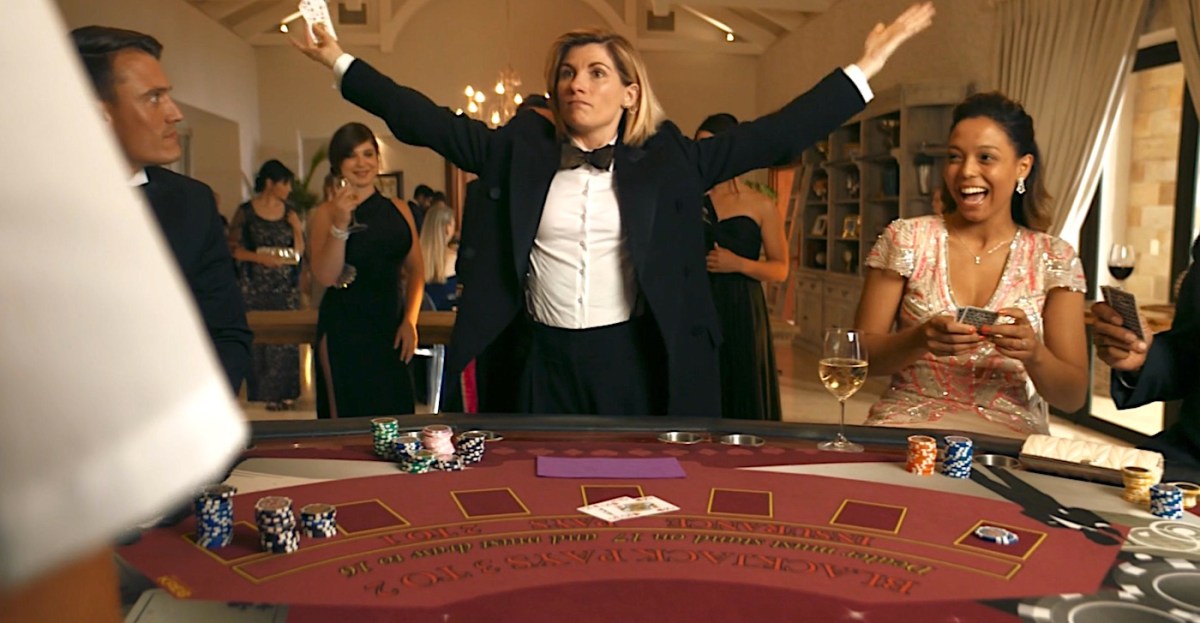
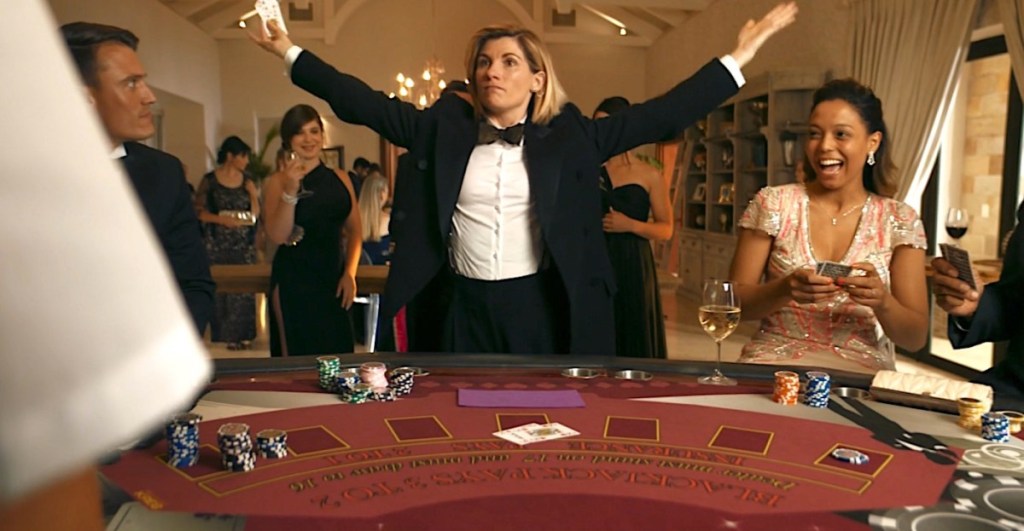
The production values on the episode maintain the high standard set by the last series, and whatever deficiencies exist in this incarnation of the show, the visuals certainly aren’t amongst them. Arguably the show has never looked better and the location filming adds an epic feel to the material with South Africa effectively doubling for the Australian outback. Director of photography, Catherine Goldschmidt, creates a very filmic look to the scenes and the rich colours of the landscape look particularly striking. First time Who director Jamie Magnus Stone impresses with the action set pieces, with the motorbike chase through the vineyard being a particular highlight. Segun Akinola continues his excellent work from series 11, with the incidental music supporting the scenes well without becoming intrusive, as things did at times during the Moffat/RTD years. That said, Akinola proves he can go the full Murray Gold when the moment requires it creating a beautiful faux Bond theme for the scenes when Team TARDIS gatecrash Barton’s birthday celebrations. The effects work, handled by DNEG TV are also unobtrusive and believable, in particular the plane crash at the stories cliffhanger.
VERDICT
Spyfall might not be classic Doctor Who, and if it aims to be James Bond then its more Bob Holness than Daniel Craig, but it is a fun opening episode and does represent improvement over the last series. The companions, though too many in number, are at least starting to ask the right questions and this new version of the Master is full of promise. The problems surrounding the Doctor remain from 2018 but with a new sparring partner to bounce off it’ll be interesting to see if part two brings Jodie Whittaker’s long hoped for ‘Earthshock moment’.
Review Score: 3.5/5
 Film Thought