Spyfall: Part Two – Review
“Previously on Doctor Who” … the TARDIS team, Ryan (Tosin Cole), Yaz (Mandip Gill) and Graham (Bradley Walsh) were last seen hurtling towards certain death on board Daniel Barton’s (Lenny Henry) crashing jet. Meanwhile the Doctor (Jodie Whittaker) finds herself trapped in the Upside Down mysterious home world of the story’s antagonists – the Kasaavin – and is unable to help save her friends. Will she be able to get out in time and how will the gang survive?
The action picks up directly where part one left off (Spyfall being the first Doctor Who two-parter since 2009’s The End of Time to not receive individual episode titles, a habit common to the ‘classic’ series). Trapped in the Upside Down Kasaavin dimension, the Doctor encounters Ada Lovelace (Sylvie Briggs), assistant to computer pioneer and polymath, Charles Babbage (Mark Dexter). Ada manages to transport them both to an invention exhibition held in 1834, where they encounter the Master (Sacha Dhawan, still with a mouthful of scenery from episode one), who despite tracking down the Doctor doesn’t understand how she could have escaped the Upside Down Kasaavin dimension. In Babbage’s office is an identical figurine to that from Barton’s office in present day Earth, which manages to summon a Kasaavin. Ada and the Doctor escape but are transported to Paris during World War II, where they are rescued by British spy Noor Inayat Khan (Aurora Marion), the first female wireless operator to be sent to France from Britain. The Master follows once again, this time disguised as an SS officer using a perception filter to pass unnoticed. After sending a telepathic message for a rendezvous, the Doctor meets her sworn enemy atop the Eiffel Tower (they’ll always have Paris) where the Master confesses the murdered spies were just a lure designed to pique the Doctor’s curiosity. He goes on to explain that Gallifrey has been destroyed. Disabling his perception filter, the Doctor leaves the Master in the clutches of the Nazis, and she returns to the present day with Ada (or so she says – “Rule one – the Doctor lies”), using the Master’s TARDIS for a quick getaway.

In the present, Ryan has safely landed Barton’s damaged jet, with the aid of an app on his phone (no, not Flappy Bird). On the run from Barton, the gang discover a warehouse containing the Kasaavin statue. Barton meanwhile speaks at a press conference where he reveals that the aliens are to rewrite humanity’s DNA in order to reformat it as a hard drive, fit for their own purpose. The Master reappears just as the statue is activated, but it fails due to a virus planted (off-screen) by the Doctor, who made a stop-off on her way back to the present day. The Kasaavins are driven back to their own dimension, taking the Master with them, once the Doctor reveals the extent of his duplicity. In the commotion, Barton escapes to die another day/contractually reappear later in the series.
After travelling back in time to install Afterburner (one imagines) on Ryan’s phone (again, off-screen – more on this later!), the Doctor returns Ada and Noor to their respective time zones and cleanses their memories of the whole experience. Travelling to the bubble universe storing her home world, the Doctor’s worst fears are confirmed – the Master is telling the truth and Gallifrey has been destroyed. The citadel lies in ruins, its glass dome smashed open like the snow globe at the end of Citizen Kane. Aboard the TARDIS a hologramatic message from the Master confesses that it was he who destroyed Gallifrey after discovering that all Time Lord history is a lie based on the “Timeless Child”. Travelling once again with her ‘fam’, the Doctor agrees to a Q&A session about her origins. She tells them they can visit Gallifrey with her… another time (remember rule one).

Spyfall is the first two-parter of what will one day be known as the Chibnall era, with 2018’s series consisting of 10 standalone stories. And as such, the purpose of part two in any two-parter is naturally, er, twofold. It has to resolve both the cliffhanger from the previous week and also close-out the overall story. The second part of Spyfall fails to satisfy either of these as both resolutions take place off screen, and both solutions need time travel to work. Surely this isn’t a massive problem in a show about time travel? Well, to quote Billy Webb in Alfonso Bonzo, “I was coming to that…”
The Doctor’s TARDIS has obviously been an essential ingredient ever since the very first episode. A magic box capable of transporting the audience anywhere and anywhen. But its inclusion causes narrative problems for the show. How do writers infuse a sense of tension/jeopardy into scenes when the Doctor’s “frankly magnificent timeship” is there to solve any problem with a flick of a switch? In the early days of the show it was easy – the Doctor simply didn’t know how to pilot his ‘ship’ and it was anybody’s guess where it would take them next. Functionally the TARDIS was no more than an unreliable car. It was there to get them into trouble, not out of it. It was the wardrobe leading to Narnia, not Aslan the lion leading them to all to safety.

As the years passed, the Doctor’s ability to pilot the TARDIS greatly improved until by the early eighties he was able to fly with pinpoint accuracy (see Logopolis, bizarrely referenced in this episode). When the series returned in 2005, it was always explained that the TARDIS couldn’t be used as a solution ever because the moment it lands it “becomes part of events”. This was an elegant solution by Russell T. Davies designed to eliminate magic fixes to the stories, and throughout his tenure this golden rule was never really broken. The only exception being The Waters of Mars where that was the very point of the story – the Doctor had gone “too far”. Mind you, in this instance all the Doctor really does is use the TARDIS as a life boat, taking the survivors off the planet. It’s not used to defeat the “Flood” by travelling back in time, nor does it undo anything that’s happened in the episode. It’s just ‘bad’ because the survivors were “fixed points” and destined to die. Realistically though all the Doctor had to do was land somewhere else and wipe their minds of their identities and history would have remained unchanged. But where’s the drama in that?
In this story, the TARDIS breaks this golden rule not once, but twice. At the beginning of the episode the ‘fam’ is saved by the Doctor by actions performed at the end of the episode off screen, and inversely at the end of the episode the Kasaavins are defeated by a virus planted earlier in the episode (also off screen). “What hand or eye could frame such fearful symmetry?”, you might ask. Why, Chris Chibnall of course.
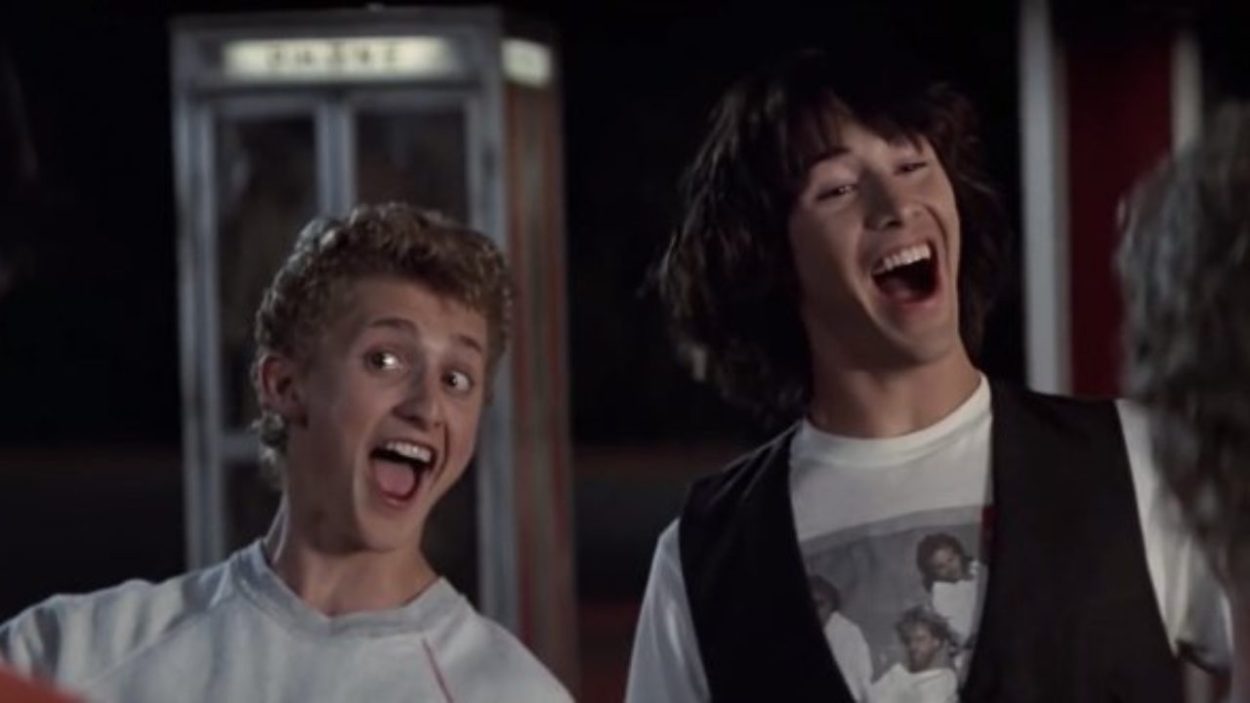
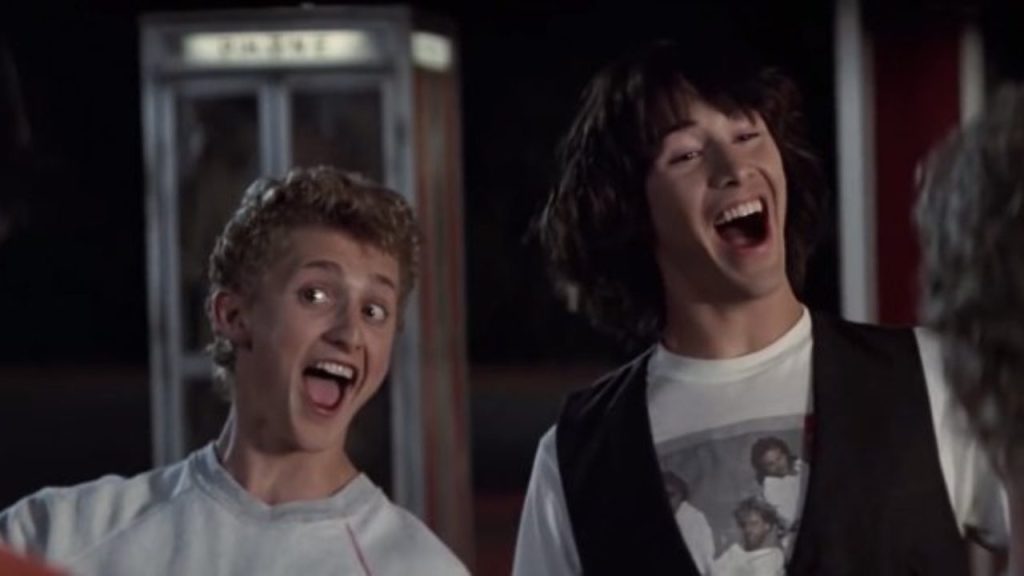
In the two Bill and Ted movies of the late ‘80s/early ‘90s, this happens all the time of course but primarily because they’re comedy films and are meant to be ludicrous. Pulling rabbits out of hats, whether literally or figuratively, is inherently funny which is why magic and comedy have such long associations. In Doctor Who though, time travel isn’t played for laughs – it’s the prime mover for drama; the artron energy that holds the show together. If you break that, then you risk breaking the story.
In true “timey wimey” fashion, solving problems in this way has consequences for the enjoyment of past and future stories. From now on when we watch old or new episodes, we’re going to ask ourselves “Why not just use the TARDIS??” For instance, take the sad ending to Steven Moffat’s 2006 masterpiece, The Girl in the Fireplace. The story closes with the Doctor standing alone in his TARDIS, distraught that he wasn’t in time to save the love of his life. With Spyfall’s logic, all the Doctor has to do is fire up the controls, pilot the ship to 18th century France and cure Reinette, faking her death so nobody is any the wiser. Anything’s possible when time travel is just “a very big to-do list”, as the Doctor reduces it to in this episode.
The other issue with these fixes is they’re completely devoid of any sense of drama. Essentially the coolest moments in these stories happen without us seeing them. The Doctor’s greatest strength is he/she improvises in the moment to solve problems. In the Caves of Androzani for example, it’s a literal race against time for the Doctor to get the bats milk in order to save Peri’s life (and his own!). The episode wouldn’t be as dramatic if instead of bravely descending into the bowels of the caves, armed only with an oxygen canister for safety, he just ran back to the TARDIS, piloted it to a week last Thursday, got the milk and saved the day. Mind you, we also wouldn’t have had the Twin Dilemma the following week so maybe there are some merits to it. Maybe it’s possible the Doctor feels free to break the rules of time again because the Timelords are gone. As Jessie “The Body” Ventura used to tell “Gorilla” Monsoon in the WWF, “Cheating’s not cheating unless you get caught.” Has the “Timelord Victorious” returned once again?
On the subject of the Timelords, there’s trouble at t’mill there too. When the show returned in 2005, Gallifrey was destroyed (off screen, as all the most exciting things seem to be these days), the Doctor forced into an act of genocide in order to save the universe. 2013’s 50th anniversary special, The Day of the Doctor, pressed the reset button on this in part because the writer Steven Moffat always felt the Doctor would have found another way. Now this happy ending has seemingly been undone and whilst the Master is admittedly a more likely candidate for mass murder its odd to return to this theme so soon. Appropriately enough for a show about time travel, the destruction of Gallifrey has now been covered more times than “Yesterday” and there’s an air or repetition about it already.
Also worrying is the implication of the teased “Timeless Child” and that everything the Doctor knows “is a lie”. The word on the street is that Chibnall might be attempting a reboot of timelord mythology in much the same way as Andrew Cartmel, script editor for the Sylvester McCoy era attempted in the late ‘80s. Tinkering with such long established lore is risky business but it is an intriguing hook for the series and Jodie Whittaker looked much more in her element sinking her teeth into such meaty stuff. For a change, she had something to react to instead of just telling us the plot, or spouting drivel.
Jodie Whittaker certainly got more opportunities to shine in this episode. Her meeting with the Master atop the Eiffel Tower was the kind of confrontation her character has been crying out for, although it did create an uncomfortable (and decidedly un-doctorish) moment. The Doctor shows surprise that the Master has been able to pass unnoticed by the Nazi’s given his new skin colour. This is a Doctor who doesn’t know the difference between poker and snap, and yet notices this. Its uncomfortable and jarring. It gets worse though because in order to escape she disables his perception filter, unveiling his real identity to the Nazis. Essentially weaponizing his ethnicity. Whatever the intentions were with the writing of this scene, the result is clumsy and unworthy of the Doctor. Perhaps you could argue she was sinking to his level. Perhaps… but in the words of the fifth Doctor, “There should have been another way.”
Addressing a problem from last series, the companions also sat around and discussed the Doctor like she was an alcoholic in denial, reluctant to share her story with the group. At this point in their journey with the Doctor it felt like a deleted scene tacked onto a series 11 box set. “Not that we haven’t asked”, chimed in Graham. No mate- you haven’t. We were watching. Any other doctor and this scene would make perfect sense but Jodie Whittaker is arguably the most open-book Doctor we’ve ever had. She can’t control her inner voice when she sees a custard cream let alone anything else. Maybe this is where they’ll take the character and if they do it’s a smart move. Along with the Cartmel Masterplan part 2 (whoahh – ‘Master’-plan) maybe we are headed down the McCoy route of darkening her personality.

Tonally things are all over the place in this episode and it lacks the consistency of part one. The scenes range from light horror in the Upside Down Kassaavin dimension, to period drama in the 1800s, to scenes involving SS officers terrorizing Paris in the 1940s, all the way to Bradley Walsh tap dancing people into submission with his “laser shoes” (no, really). Doctor Who often mixes up genres but in this instance, it bites off more than it can chew.
As suspected last week, Lenny Henry’s Daniel Barton was also relegated into third billing in this episode and barely appears save for a spot of matricide near the very end. However, his character lives to fight another day so no doubt we’ll be seeing him soon in the finale. He made an impact though with what little he had to work with, so it’s definitely something to look forward to.
VERDICT
It’s a shame really because there’s lots to like in the episode, and for the most part it’s not too far behind episode 1 in terms of quality. However, a wildly inconsistent tone, a plodding pace and Bill and Ted style shenanigans damage it. An interesting arc is set up at the end but the potential for repetition is an early concern.
2.5/5
 Film Thought