
Praxeus – Review & Thoughts
In popular fiction, birds have always taken on a spiritual, even supernatural aspect. From the raven in Edgar Allen Poe’s poem of the same name to the Albatross in Coleridge’s The Rime of the Ancient Mariner, our winged friends have often been portrayed as harbingers of doom, bringing death and destruction in their wake.

In March 1963, whilst Doctor Who’s fledgling “An Unearthly Child” script was first taking flight on Anthony Coburn’s Remington Portable, Alfred Hitchcock unveiled his latest movie, the taught ornithological thriller, The Birds. Based on the 1952 book of the same name by Daphne du Maurier, the story focuses on a series of mysterious bird attacks on the residents of Bodega Bay in California, and left an indelible mark on cinema history. In the movie, the bird attacks remain ambiguous throughout but Hitchcock later elaborated that they symbolised something much deeper; a revenge against mankind for its cruel neglect of nature.

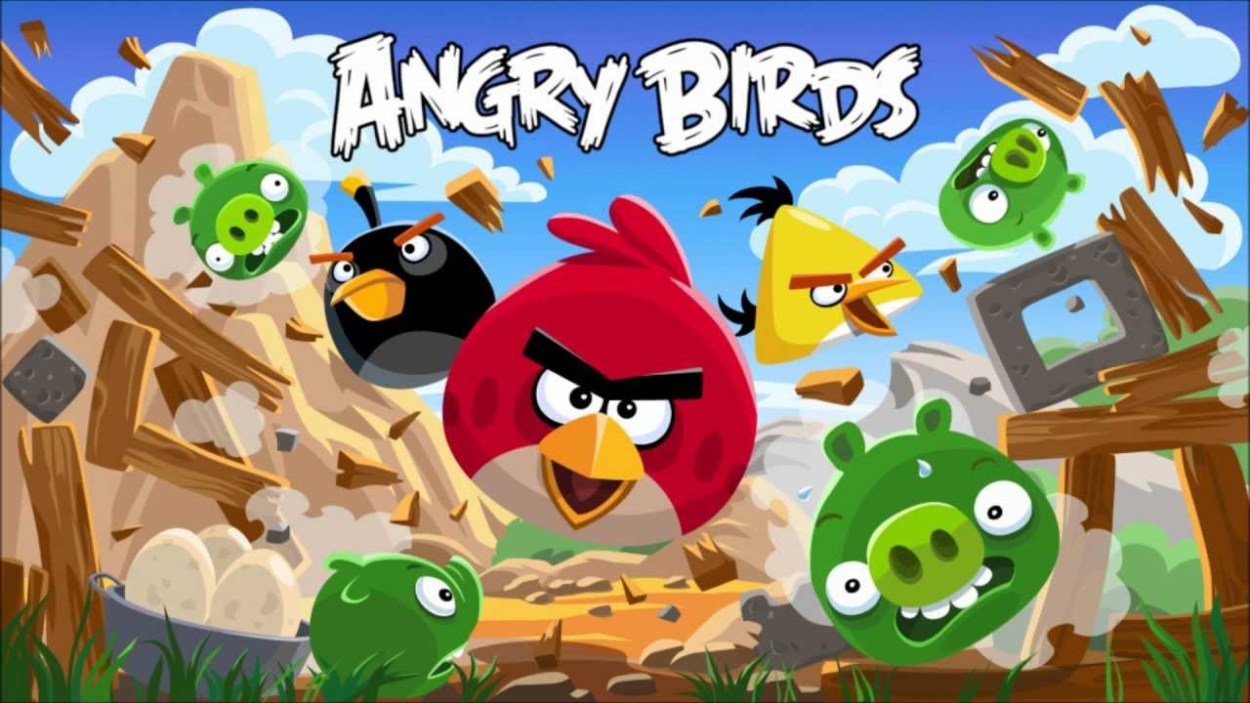
Contuining Hitchcock’s fine work was Finnish computer game developer Rovio, who in 2009 unveiled to the world their casual puzzler (I can’t think of a more apposite epithet for modern Doctor Who than “casual puzzler”) Angry Birds. As in Hitchcock’s eco-thriller, the titular tits of Angry Birds are also in a flap over their world being ruined, this time by the Orwellian ‘pigs’; a thinly veiled metaphor for mankind.
The ‘tern-based’ combat of Rovio’s game mirrored the bird’s motives of Hitchcock’s and du Maurier’s source material; their world had been spoiled and humanity (well, the pigs) must suffer the consequences. And they must give them back their eggs.

Similar themes abound too in the sixth episode of the current Doctor Who series, Praxeus, a story about the world’s avian population exacting revenge on society for its ecological neglect. With a series of mysterious energy signatures being detected across the planet, and mysterious deaths, is there fowl play at work? And where is Bill Oddie while all this is kicking off?
This week’s on-the-beak story begins with a British spacecraft crashing to Earth, its systems failing; all hope apparently lost. Meanwhile we are introduced to ex-police DI Jake Willis (played by Warren Brown, Luther’s very own DCI Ripley, believe it or not?) who is working as a security guard in a supermarket, before being fired. Elsewhere, in deepest-darkest-Peru, we meet video bloggers Gabriella (Joana Borja) and Jamila (Gabriela Toloi), “Two Girls Roaming” (Tippi Hedrens for the social media era), who have travelled there to see the world’s “most beautiful river”, only to discover it’s become a dumping ground for plastics. As they camp for the night, a flock of blackbirds circle menacingly overhead (singing in the dead of night), attacking the terrified Jamila, whilst Gabriella sleeps. Caw, blimey!
Back in the UK, Jake is drowning his sorrows in a bar and catches a BBC news report on the TV about the missing British astronaut, Adam Lang (who hopefully isn’t related to The Lodger’s “rude, rude Mr Lang”). Visibly upset, Jake receives a text message on his phone from an unlisted number, who identifies himself as Adam and asks for Jake’s help in finding him in Hong Kong (even providing a Google Maps reference).

In the morning, unable to find Jamila, a panicked Gabriella meets the Doctor’s companion Ryan (Tosin Cole) who is on a mission of his own. He warns her to stay away from a dead crow (which I’m choosing to name Sheryl, purely for my own amusement), before carefully scooping it up with a cloth and putting it in his backpack.
Arriving in Hong Kong, Jake meets the other members of the ‘fam’, Graham (Bradley Walsh) and Yaz (Mandip Gill) who help him to break into a warehouse in search of the missing Adam.
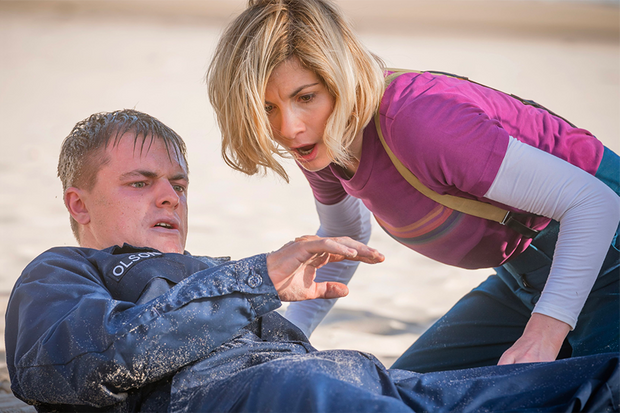
In Madagascar, the Doctor (Jodie Whittaker) rescues a survivor from a missing American submarine who has washed up on the beach. There she also meets Suki Cheng (Molly Harris) and Amaru (Thapelo Maropefela), medical researchers working in Madagascar. Spikey, coral-like growths spontaneously cover the body of the lost naval officer and he explodes in a shower of dust, leaving the Doctor to ponder on the rime of this mariner.
Meanwhile, on the trail of the lost Jamila, Gabriella and Ryan track an emergency services callout to a local hospital nearby. There they find Jamila’s body which disintegrates just as the body in Madagascar did – these deaths are connected!
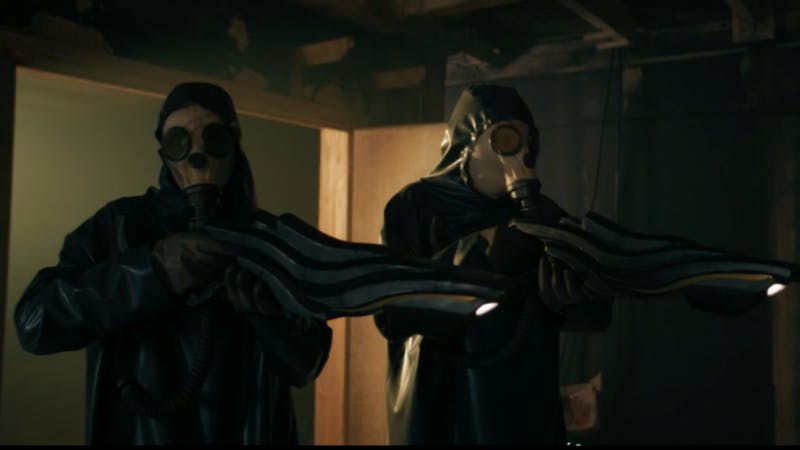
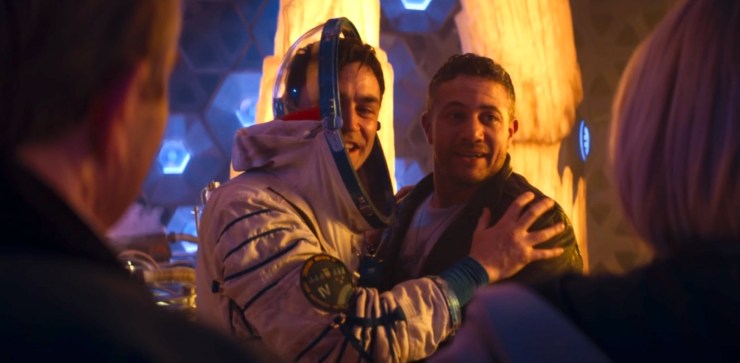
Back in the Hong Kong warehouse, the gang find the missing British astronaut (Matthew McNulty) who is held captive and is wired up to alien machinery. As they try to untie him, armed men appear wearing hazmat suits and gas masks, firing energy weapons at them. Grabbing Adam, the ‘fam’ get the flock out of there. Jake picks up a laser rifle and returns fire, killing their would-be attackers. They meet up with the Doctor and friends who take Adam and Jake to Madagascar whilst Yaz and Gabriella stay behind to investigate the equipment left in the warehouse.
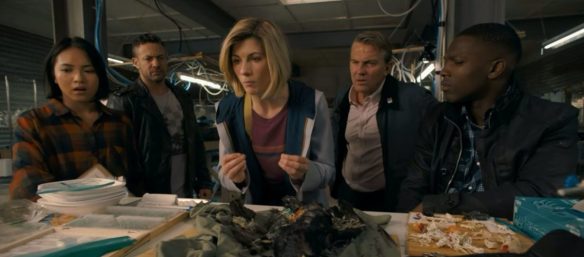
Inside Suki and Amaru’s Madagascan laboratory, Ryan dissects ‘Sheryl’ whilst the Doctor analyses Adam’s blood. The results aren’t promising and show he’s being attacked by an alien pathogen; a micro-organism that carries disease and its killing him just like the others. It’s also revealed that Adam is Jake’s estranged husband – the two having split up prior to the beginning of the episode.
Back in the warehouse, Gabriella (who seems unusually chipper for someone whose friend died 5 minutes ago) and Yaz discover a teleport station and decide to use it to ‘beam up’ to where the hazmat soldiers came from: Two Girls Roaming V2.0. On arrival they find themselves in what appears to be an alien colony, along with the remains of the missing American submarine.
Back in Madagascar the Doctor and Suki hatch a plan to create an antidote by reverse engineering the virus, which they discover is being transmitted through plastics consumed by the birds. Outside the lab, Amaru is attacked and killed by a swarm of birds, never to be seen or mentioned again (its like that with friends, this episode. Friends are disposable – plastics are not). Suki is revealed to be an alien scientist (from an unnamed species), seeking a cure for the ‘Praxeus’ virus which has devastated her (unnamed) home planet. She teleports to safety just as the birds break through the glass ceiling of the laboratory.

The gang make a swift exit in the TARDIS and on board, Adam persuades a reluctant Doctor to begin human trials of the antidote on him, whilst they track Yaz’s comm-dot signal back to its source. The TARDIS lands in an alien colony at the bottom of the Indian Ocean. Disappointingly for Yaz (and ironically also the audience at home) she is not on an alien planet. They’re at a site of pure Praxeus, which has formed at a naturally occurring fissure on the sea-bed. Exploring the sea-base the gang catch up with Suki who reveals she deliberately infected the Earth in order to seek a cure for her homeworld.
With scratches on her arms from the birds attack in the laboratory, Suki has been testing the Doctor’s prototype vaccine on herself. However, the cure only works on humans and as familiar coral-like growths cover her body, she succumbs to the Praxeus virus; exploding just as the others did. The Doctor sets an auto-pilot program on Suki’s ship, so it will fly to the Earth’s stratosphere, where its organic fuels cells will discharge the vaccine, killing Praxeus once and for all.
However, the auto-pilot fails and as the gang head back to the TARDIS, to avoid the imploding base being crushed by the Indian Ocean, they discover Jake has remained behind to manually pilot Suki’s spaceship. He succeeds and the cure is dispersed into the atmosphere just as the ship breaks up – the Doctor materialising the TARDIS around Jake, just at the moment of detonation. Reunited, Adam and Jake reconcile their differences and decide to go vlogging with Gabriella.
After the introspective, potentially continuity-busting, events of last week’s story (Fugitive of the Judoon), this episode is a return to more familiar territory for Chibnall Who. Praxeus was written by Pete McTighe and Chris Chibnall, the former having previously been responsible for 2018’s Kerblam, a story also featuring deadly plastics; that time – killer bubble wrap. In hindight its perhaps surprising seeing Chris Chibnall credited as the co-author of the story since there are no obvious connections to the Timeless Child series arc. Perhaps it’s a sign that the episode needed to be heavily rewritten, that Chibnall felt the need to share a portion of the writing credits. On the merits of the final episode, it could probably have done with another rewrite or two.
The 1963 movie the episode borrows so much of its imagery from, doesn’t provide a narrative reason for its bird attacks, although one of the characters in the film does relay a story of an incident that took place in Capitola, California, where a group of birds attacked an entire community, driven mad after consuming toxic algae. Praxeus takes its cue from this source material but swaps out toxic algae for alien-infected plastics, introducing to the narrative the twin zeitgeists of ocean plastics and killer viruses (the latter being merely a timely coincidence as the Corona Virus hadn’t been identified when the episode was being written).
It’s a shame the focus shifts from the birds because the scenes where they attack are scary in that quintessential Doctor Who (and Hitchcockian) way of taking ordinary things and making us fear them. Just as 2007’s Blink forever changed the way we look at stone statues, there was the potential for the birds of Praxeus to migrate children behind their sofas. Shifting the threat from the birds to the more nebulous alien virus, robs the episode of its principal antagonists and also its sense of danger.
Despite the episode having a very Russell T Davies vibe to it (dysfunctional relationships, gay marriage, multiple locations), Praxeus itself presents a very Steven Moffat-like problem – no monster-of-the-week wanting to take over the world, just a quirk of nature gone wrong. However, if we compare the story to 2008’s “Silence in the Library”, we can see a difference in approach to the antagonists. The Vashta Nerada of that story are an unconventional Doctor Who monster (essentially just carnivorous dust particles) but their potency is increased by giving them a physical presence (and nudging them gently towards becoming ‘conventional’ Doctor Who monsters); turning them from easily avoided shadows to pursuing Scooby Doo skeletons; “swarms in spacesuits”.

In Praxeus however, the infected hosts explode once contaminated, squandering an opportunity to create a new, more memorable monster. Perhaps the production team were worried about adding to the world’s plastic problem by creating thousands of ‘Infected Praxeus monster’ action figures. An empty (recycled) cardboard box ‘containing’ the Praxeus virus is surely more ‘on-message’.

A common complaint levelled at this incarnation of Doctor Who is the abundance of companions, and the problems of giving them ‘meaningful’ things to do. This episode tries to mask this problem by splitting them up early doors. Whilst this divides the narrative it isn’t the same thing as giving them ‘meaningful’ things to do. This approach is quite reductive as the companion’s roles are reduced to a series of video game-like ‘fetch quests’. There are also inconsistencies in how they’re characterised. Whilst it makes sense seeing Graham administering IV lines into Adam’s arms, recalling his prior cancer treatments, Ryan is simply handed a scalpel and asked to dissect a bird without any mention of his coordination problems (dyspraxia). The visiting cast don’t fare much better either as Gabriella seems to totally forget the gruesome death of her close friend of 5 years, even jovially accepting Yaz as the new member of “Two Girls Roaming”, a mere ten minutes later. The Doctor fares slightly better at the start of the episode, appearing confident and dynamic, until the event horizon of the writing sucks her back to just whirling the sonic around and filling in the many holes in the plot. These scripts need to start ‘showing’ instead of ‘telling’.
On the subject of plot holes, it’s clear that Praxeus shares another similarity with Rovio’s computer game, Angry Birds – it has no replay value whatsoever. The fast paced opening scenes are clearly designed to prevent eagle-eyed viewers from noticing the numerous plot holes. On a second viewing these particularly stand out. For instance, Jakes comes to his husbands rescue because he receives a text from him. Why would an astronaut carry a mobile phone (I guess the signal from the International Space Station must be amazing) and where on earth does he keep it (hopefully not in the same place as Captain Jack keeps his “Compact Laser Deluxe”)? How does he manage to text his ex-husband even from captivity, as if he’s merely dialing an Uber? When Jake finds him, he’s trussed up to machinery like a medieval torture victim, with his arms wide apart. Either he’s really great at using Siri on his phone (messaging with caps lock on, no less), or the scene doesn’t make a lot of sense. In any case, why was he permitted to send the message anyway? Its clear the writers don’t have a dickie-bird either and its not addressed in the episode. Maybe this is what Chris Chibnall’s contribution was in the rewriting process; keeping things moving things at such a pace we’ve not got a chance to pause and think about them. “Look! We’re in Peru now – don’t think about that text. Here’s something else!”

For an episode tackling such complex real world problems, the solution to Praxeus is childishly simplistic. Essentially the Doctor makes a cure for the virus and then ‘chem-trails’ it through the stratosphere. Why this virus would cure the birds though, when its designed for human biology, isn’t explained satisfactorily on screen. Neither is why the Doctor doesn’t travel to Suki’s planet and try to save that from the Praxeus virus either, once she’s learned about it. Also the miraculous last second rescue of Jake from the disintegrating ship, also creates a historic plothole – namely the failure of the Doctor to perform a similar rescue mission in 1982’s Earthshock. God, the Doctor must have really hated Adric!

Ironic Message of the Week
This week’s ironic message is that a show making millions of pounds from selling plastic toys to its audience each year, warns its audience about the evils of plastic.

Right: Good plastic
In fairness to Praxeus, it is a lot less preachy with its messages than Orphan 55. In that story, mankind directly creates the monster of the week – the lazily named Dreggs – and the audience is told off for doing so by the Doctor at the end of the episode. In Praxeus however, the oceanic pollution is merely the conduit for the alien virus, not the direct cause. This subtly shifts the blame and moves Praxeus into less sanctimonious waters, albeit the Dreggs of Orphan 55 ultimately make for a better monster than a unseeable alien virus.
Aside from the ecological themes of this week’s episode, there’s also a curiously un-Doctor Who subtext running through the narrative. In the past, the show has always championed the ordinary lives of humans, whether that’s Rose and her love of chips, or Mr. Stay-at-home, sofa-man Craig in the Lodger; their ordinary lives were fascinating to the Doctor. They represented the one adventure he/she could never have and weren’t things the Doctor looked down on. However Praxeus, consistent with the themes already explored this series, takes the reverse approach. In this story Jake is portrayed unsympathetically because he doesn’t share his husband’s devil-may-care lifestyle. He doesn’t enjoy foreign travel and likes his ordinary life (which is as a police DI – its not exactly “pizza-booze-telly”). In the world of Chibnall Who though, vloggers living in Peruvian tents are championed and police men with steady jobs are ridiculed, just as steady-Eddy Edison was viewed in a poor light in comparison to recklessness of Tesla, a few weeks prior (despite Edison’s ‘inventions’ being all around us). Even Charles Babbage, inventor of the world’s first computer was dismissed as a dullard in Spyfall, in favour of the more ‘exciting’ Ada Lovelace.
Despite the overseas filming in Praxeus, the production values seem lower in this episode too, as if the money has been saved for the series finale. The sets are drab and unimaginative and the hazmat suits of the alien race conjure up unfortunate images of “Daddy” from the third series of The League of Gentlemen (or maybe that’s just me?). I’m not sure that’s the look costume designer Ray Holman was going for when he was handed the brief for the episode.

VERDICT
Following the excitement of last week’s story, Praxeus disappoints with a story that sacrifices thrills in the pursuit of preaching mixed-messages to its audience. After this adventure with the Doctor, Yaz and the plastic population, perhaps the only way is up.
Nothing to crow about: 6/10
 Film Thought