The Haunting of Villa Diodati – Review and Thoughts
Before we begin, let’s get something clear right from the outset. Doctor Who isn’t science fiction – it’s horror, albeit horror dressed in the clothes of science fiction, in much the same way as Alien is a haunted house in space. For all its neutron flow reversals and sonic screwdrivers, Doctor Who is, at its two hearts, a show about scary monsters creeping up on people out of the dark. Within the horror genre, Frankenstein in particular resonates with the show. Its creature has inspired a countless ‘classic’ monsters over the years (including obviously the Cybermen – shhh, spoilers), and Mary Shelley’s story was even reimagined for 1976’s The Brain of Morbius starring Tom Baker (himself a former star of Hammer horror movies).
The Doctor herself is a bit like Frankenstein’s monster (indeed, Morbius, from the aforementioned story, was also unsurprisingly, a Timelord) possessing the ability to come back from the dead whilst remembering past life experiences. She’s even rocked a dinner jacket in a number of her past incarnations. In fact, in the 1996 TV movie, as Sylvester McCoy’s 7th Doctor gurned on a gurney, transforming into Paul McGann’s Byronesque 8th Doctor (Byron – again… spoilers), the mortuary attendant was watching the classic 1931 Boris Karloff version of Frankenstein on the television. Subtle it was not.
In this week’s story, the eighth episode of the current series – The Haunting of Villa Diodati (hey, catchy title!), Frankenstein’s author Mary Shelley makes a long overdue appearance. The Doctor decides to pay Mary a visit on the night she conceived the story for her graveyard smash, Frankenstein. However creepy and kooky things are going on at Villa Diodati and history could be at stake. Be afraid; be very afraid.

Things begin with a cold opening, a very cold opening, as unseasonably terrible weather plunges Lake Geneva into inky blackness, in June 1816. As lightning strikes all around Villa Diodati, Byron (Jacob Collins-Levy), Mary Shelley (Lili Miller), Claire Clairmont (Nadia Parkes) and Dr John Polidori (Maxim Baldry) are ‘enjoying’ a rainy summer holiday (we’ve all been there before).
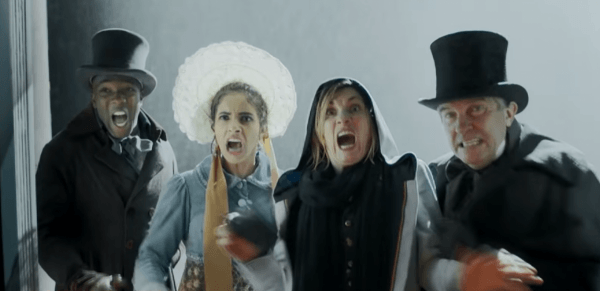
Spooky things are going on in Aston Villa (I’ve already forgotten its real name) – vases are throwing themselves across rooms, door handles are mysteriously rattling a terrible crashing sound is heard. Timidly opening the front door, Byron and Shelley (an ITV detective show if ever there was one) are startled to see the Doctor (Jodie Whittaker), Ryan (Tosin Cole), Yaz (Mandip Gill) and Graham (Bradley Walsh) (who bizarrely seem really shocked at somebody answering the door – they knocked it!) standing in the rain.

On an evening of such important historical significance, the Doctor has a few ground rules (“You must not talk about Frankenstein, you must not talk about Frankenstein…”) so the ‘fam’ (urgh) are to be on their best behaviour. After a quick dance-off with their new hosts, Graham leaves to find the ‘little boy’s room’ whilst the Doctor breaks her own rules and tries to give history a little helping hand by suggesting the party comes up with scary stories. But nobody is interested in writing and besides, there’s a bigger problem – one third of the evening’s triumvirate is missing. Where is Percy Shelley??
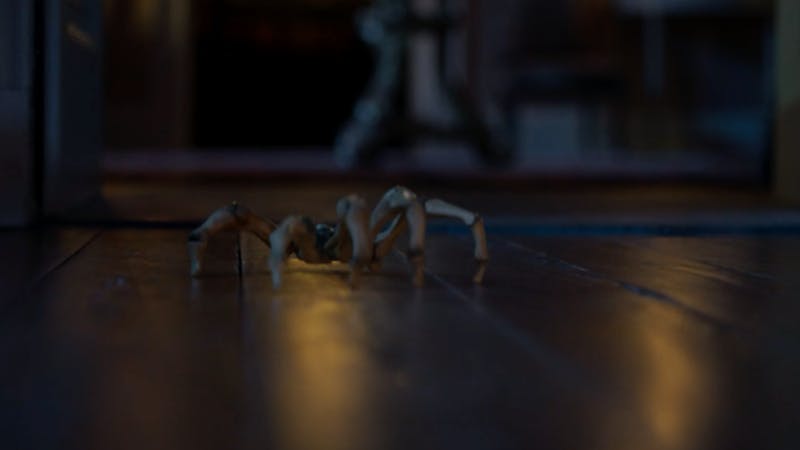
After a tense scene where Graham can’t find the loo (well it was tense for me but then again, I am over 40), a painting spontaneously falls off the wall; a dismembered skeletal hand bursting through the canvas and lurching menacingly across the wooden floor. Graham, still looking for the toilet, finds that the house’s architecture is taking him around in circles – every path leads right back to the beginning.
Meanwhile, Yaz is on the trail of Claire, whom she noticed pocketing a table knife earlier (well, Police Officers are ever alert to the potential dangers of knife crime). Claire is using the knife to try to force the lock on one of the rooms. She explains she’s looking for one of Byron’s letters, that’ll hopefully reveal his true feelings towards her. Yaz sympathises with her new friend, confiding she is in a similar predicament with a mystery person (does Yaz fancy the Doctor?? – its certainly implied here! Is the show going here?)
Meanwhile, back in the drawing roon, the Doctor is scanning the room with her sonic screwdriver (its 10 minutes into the episode and its making its first appearance – something of a record). She’s more and more convinced that something evil is going on at Aston Villa (there is – it’s called relegation).
In another room in the house, Ryan is impressing Mary with his piano skills, whilst Polydori eyeballs him menacingly from across the room. “Is that popular in the colonies?” asks Mary, indulging in a spot of casual racism (which is portrayed surprisingly sympathetically). Polydori and Ryan trade insults and the (bad) doctor leaves the room to retrieve his duelling pistols (well, who doesn’t pack those when they go on vacation?). Opening the door, he’s startled to see the skeletal hand from the painting cross the threshold. The ‘thing’ springs into the air closing around Ryan’s throat. As Ryan prizes it off, and flings it into the air, the valet smashes it to the ground with his silver tray. “Good shot!”, exclaims the Doctor.

Polydorri points the finger of blame at Byron, explaining the evil in the house is because he brought a skeleton to the party (you’ve got to begrudgingly admire the double standards of a man who brings duelling pistols to a party, criticising a man who brings a skeleton). The skeleton belonged to a 15th century soldier from the Battle of Morat and its missing its hand!
The Doctor decides to go outside for a breather, whilst Yaz and Ryan look for the missing Shelley. As they move about the house, they all experience the same spatial distortion; running around in circles – the house seemingly not wanting them to leave.
To the Doctor’s surprise, Polydorri suddenly walks through the wall and into the drawing room. He’s sleep-walking and the Doctor deduces that Polydori’s unconscious brain is oblivious to the house’s illusion; a perception filter keeping them trapped in the Villa (Jack Grealish has the same problem).

Out of the window, across Lake Geneva, the Doctor sees a bright, spectral shape floating above the water. Somebody trying to break through time; a fellow traveller. The mysterious figure appears in the villa and is revealed to be the lone Cyberman (or just ‘a’ Cyberman, in any other series of Doctor Who). Yaz and Graham recite Jack’s warning from their adventures with the Judoon – “Don’t give him what he wants”. The Cyberman is looking for something (hopefully not Byron’s letters).
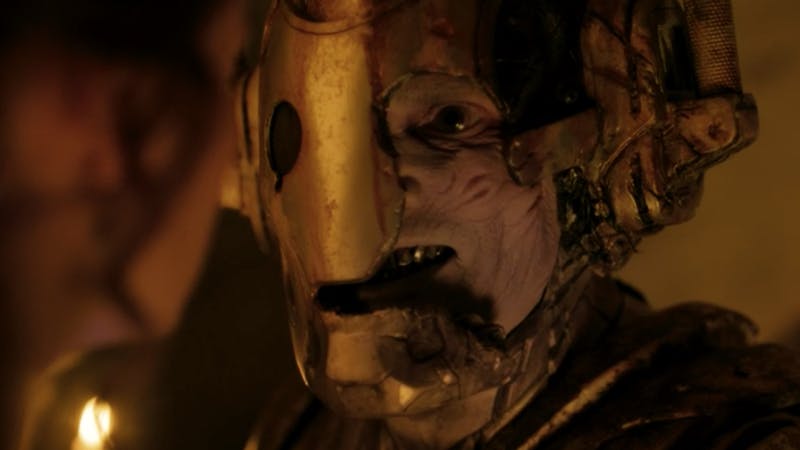
The Doctor finds the Cyberman in the nursery. Up close we can see this Cyberman is severely damaged from his temporal displacement. He has cracks in his armour and his face mask is split down the centre, hanging half off his face like the Phantom of the Opera. Reaching a hand outside the window, the Cyberman is zapped by a bolt of lightning, powering up his circuits and reactivating the laser canon mounted on his wrist. The Cyberman is after something called the Cyberium, which he intends to remove from its mysterious host – “the Guardian”. Suddenly crackling with energy, the Cyberman starts to recite Shelley’s words; he’s also looking for the missing poet.
Meanwhile, the ‘fam’ split up and begin exploring the haunted mansion. Yaz and Ryan find Shelley’s room, which has papers strewn across the floor and strange symbols written on the walls. Meanwhile, Graham and Mary discover Shelley hiding in the basement. He seems dazed confused, introducing himself as the Key-Master Guardian.

Joining the others, the Doctor scans the disorientated poet with the sonic screwdriver. Shelley says he’s trying to protect the Cyberium just as the Cyberman suddenly materialises in the basement. The architecture of the house shifts again, transporting the Cyberman to another part of the villa and keeping the ‘fam’ safe for now. Scanning Shelley’s brain, the Doctor watches what would be part 1 of the story, if it was part of the ‘classic’ series – the backstory. She sees a vision of Shelley wandering besides the lake where he stops to pick up something shimmering beneath the water’s surface. Its a molten metal (“like quicksilver”) which dissolves into the palm of his hand, spreading quickly throughout his body, taking him over. When he returned to the house nobody could see him (it was Shelley who was smashed vases, rattled on door knobs and er, played with skeletons).

The quicksilver is the Cyberium; the AI knowledge of the whole Cyber-race (Cyberspace??) The Doctor surmises that somebody took the Cyberium and sent it back through time to try and change the future; to stop the lone Cyberman from getting his grubby mitts on it. Graham and Yaz warn the Doctor about Jack’s prophecy again. “Armies will rise and billions will die”. But Shelley WILL die if the Cyberium stays inside him. One man’s life versus billions of others in the future? Does the Doctor have the right (sorry – wrong episode)? Strangely, the Doctor decides that nothing is more important than a writer’s life. Shelley dying before his time could unravel the whole future – even meaning that Ryan was never born (so it’s not all bad then). “Save the cheerleader poet, save the universe”. The Cyberman reappears, this time to execute the host and extract the Cyberium from his corpse. Mary intervenes (observing how the Cyberman is a composite man – made up of bits and pieces. Very subtle!) and tries to reason with him. He didn’t kill baby William earlier, when he had the opportunity earlier to do so, therefore he won’t kill Shelley. The Cyberman, who reveals he used to be called Ashad before his conversion, denies this and lurches forward to attack.
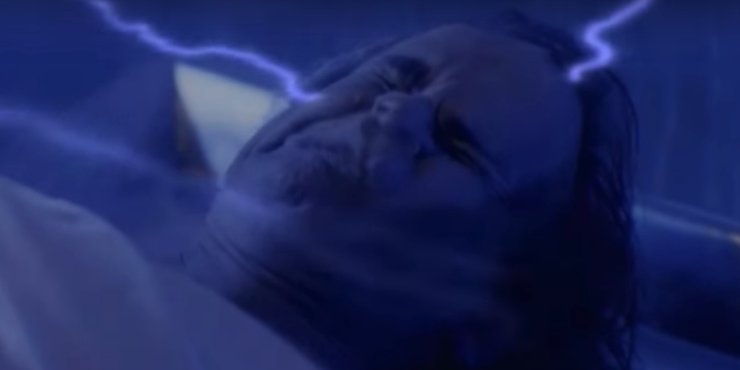
The Doctor employs an old Timelord trick, giving Shelley a vision of his own death (as party tricks go it’s on a par with bringing duelling pistols and skeletons), tricking the Cyberium into leaving his body, believing him dead. Shelley convulses as he spews the quicksilver of the Cyberium out of his mouth and into the cold air of the basement. The Doctor absorbs the Cyberium and assumes the role of the Guardian. The Cyberman threatens the Doctor, transmitting a message to his army who will lock onto his signal and “tear this reality” apart. “We are inevitable”, says Thanos Ashad. Agreeing with him, the Doctor releases the Cyberium (a sort of silver space fart) from her body and the Cyberman teleports away with his prize. The Doctor has endangered the whole future with her decision to save Shelley. Shelley gives them the symbols and numbers he copied down from the Cyberium, which include coordinates for the Cyber-fleet.

Ironically for a tale involving Mary Shelley, The Haunting of Villa Diodati (I looked up its title again), is itself a Frankenstein’s monster. The narrative of the lone Cyberman is surgically grafted onto the cadaver (and it is a dead body) of the plot of the Shelley’s fateful meeting with Byron. However, once the main plot kicks into gear, the historical characters are relegated in favour of the series arc, just as with Fugitive of the Judoon, 3 weeks ago. It does make you wonder what was the point in using this particular setting, given how little importance is placed on the Shelley’s and Byron. Prior to transmission Chris Chibnall even described first time Doctor Who writer Maxine Alderton as an “expert in Byron and Shelley”, which makes it all the stranger. Byron in particular is extremely poorly served by the narrative. This is a man who is revered as one of English literature’s greatest poets (not that the Doctor is impressed – she prefers Shelley. Well, who doesn’t like a bit of Hywel Bennett?), who fought the Ottoman empire and who has inspired countless generations of writers. And yet in The Haunting of Villa Diodati, he seems a bit of a prat, to put it bluntly. He uses Claire Clairmont as a human shield, makes inappropriate advances to the Doctor and seems generally unimpressive. Unbyronesque, you might say.

The spooky setting however certainly benefits the narrative but it could have been set anywhere really, even in the present day. Shelley and Byron could just have been plain old Mary and George, a couple the Doctor meets on her travels. Usually in a celebrity historical, the story wouldn’t be possible without them, but in the Haunting of Villa Diodati the story happens in spite of Shelley and Byron. This has been a weakness of this series as a whole. In a lot of episodes, the settings don’t add anything to the story; they’re just window dressing to make the episode more enticing. For example, there was no real reason why last week’s episode began in 14th Century Aleppo, no particular reason why Praxeus was set in Peru, nor why Spyfall hopped around the globe. The Lone Cyberman could have appeared in any time period (I like to imagine a present-day set version of this story where instead of the Shelley, the Cyberman recites the Gruffalo). Shelley wasn’t intrinsic to the plot, nor its resolution, and many of the Frankenstein references are from the Boris Karloff movies, instead of the source material itself.

On the subject of the Cyberman, the appearance of the Ashad is a bold reimagining of the Cybermen. Never before have we seen a Cyberman who has a name, let alone human emotions, thanks to a missing ‘inhibitor chip’. This is a Cyberman who we can believe would watch a sunset, smell a flower, even appreciate a well-prepared meal… right before ripping your head off. Ashad has a human hand, meaning he literally feels, he has an understanding of comic intent (“funny” he says when the Doctor cracks wise) and who feels frustration and irritation (“You irritate me”, he says to Jodie Whittaker’s Timelord. We sympathise, Ashad). It’s an unnerving concept and the episode more or less pulls it off. His battle-damaged amour seems more Borg-like than ever in this episode, even if it occasionally conjures up unfortunate memories of Red Dwarf’s Simulant race (itself a gentle pastiche of Doctor Who’s second most famous antagonist). As the show’s very own Frankenstein’s monster its thematically fitting that Ashad regenerates himself with a bolt of lightning, bringing to mind a similar trick a lone Dalek managed in 2005. It’s a fitting image even if the script is particularly clunky in these scenes with the Doctor over-explaining the very apparent plot and the Cyberman talking less like Frankenstein’s monster and more like Frankie from the Ghastly Goolies (“I needed that”).

Circle of Inspiration
The Cybermen were originally inspired by Frankenstein’s monster but within the fiction of the show, Frankenstein’s monster is now inspired by the Cybermen. The Borg in Star Trek were (in part) inspired by the Cybermen but now the Cybermen have taken inspiration from the Borg. Frankenstein inspired The Terminator and now Cybermen travel through time like Arnie on the hunt for Sarah Connor. It’s all weirdly reminiscent of the time Richard Madeley starting speaking in Alan Partridge-isms to appear cool, seemingly oblivious to the fact that his mannerisms were the original inspiration for the character.
Ironic Message of the Week
“Words matter”, in a script where they clearly don’t.
In all fairness, this is a largely successful episode, and certainly one of Jodie Whittaker’s best stories to date (I may even go as far as to suggest ‘the’ best). However, the episode is a triumph of style over substance and on a second watch there are a few things which remain unexplained or worse are unexplainable. Some of the more confusing aspects to the narrative are:
- What was the business with the skeleton about? Did an invisible Shelley really move it around the house for fun?
- Why would Shelley dying mean Ryan doesn’t exist any more? Are they related, Back to the Future style?
- Why did Graham see ghostly figures in the house (the audience even saw them before Graham, so it couldn’t have just been in his head).
- Did Graham ever find the toilet?
VERDICT
Like a lot of episodes this series, The Haunting of Villa Diodati functions merely as a 50-minute teaser for the season finale. Things start slowly but the lightning bolt that brings Ashad back to life had a similar regenerating effect on the narrative. Plot holes and minor niggles aside, this is a high point for the series and one that builds excitement for the finale.
7.5/10
 Film Thought